Coastal engineering hero — wave flume laboratory test — Program imagery, coastal engineering cluster.
Case Study

Marine Mammal Science

A research master's in marine mammal population assessment. This is a graduate program — the route in for undergraduates is a bachelor's degree in marine biology first.

This is a graduate program. It is the specialization more prospective students write to us about than any other, and a large share of those letters come from people still in high school. If that is you, the honest answer is that the route in is the BS in Marine Biology, and that four years later you would be a strong applicant here. Several of our current students arrived exactly that way.

The degree is a research master's in marine mammal population assessment: the science of estimating how many animals there are, where they are, and how those numbers are changing, from data that are sparse, biased and expensive to collect.

Why it is graduate level

Because the interesting problems are statistical, and the statistics assume a foundation. A population estimate for a whale or a seal is built from sightings shaped by weather, observer, platform and luck. Turning that into a number with a defensible confidence interval requires population biology and quantitative methods that a four-year degree is where you acquire.

A program that admitted students without that foundation would spend its two years teaching the undergraduate degree again.

What you study

Marine mammal biology, population dynamics, and data analysis for ocean science, alongside a research thesis that occupies most of the second year. The methodological focus is on integrating data types that were historically analyzed separately — visual survey, passive acoustics and photographic identification of individuals — each of which has a different blind spot.

Field work

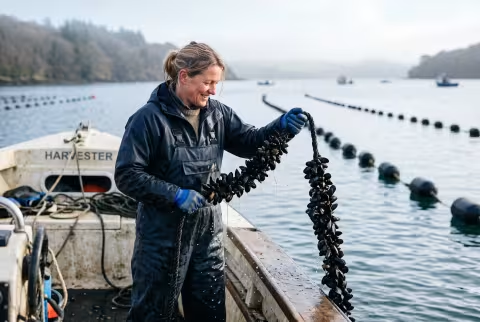
Survey work is seasonal and weather-dependent. Students should expect time at sea and at Prentice, and should also expect that a planned survey week will sometimes produce no data at all. Learning to design around that is part of the training.

Where it leads

Agency stock assessment, consulting for offshore development, conservation organizations, and doctoral study. Graduates of the first cohort are working in all four.

Curriculum

MBIO 310 Marine Mammal Biology

The biology of cetaceans, pinnipeds and sirenians, and the survey methods used to study animals that are underwater most of the time.

1
MBIO 520 Population Dynamics of Marine Mammals

Graduate-level population assessment for marine mammals: estimation, uncertainty, and the integration of survey types that each fail differently.

2
OCEA 450 Data Analysis for Ocean Science

Working with real ocean data: gappy, noisy, unevenly sampled, and nothing like a textbook dataset.

1.5

Common questions

Yes, for all students entering directly from high school. Transfer students are housed as space allows, and the waitlist usually clears by mid-July.

Housing and residence life

Accordion content - Officiis porta iusto luctus maecenas ultricies libero quisquam commodi do sequi facilisis, accusamus aut? Sapien dignissim nascetur nesciunt phasellus eros dis cupidatat tempor egestas cillum eveniet lobortis, sunt eos tellus atque quaerat, voluptatem exercitationem voluptatibus nesciunt, eveniet in dicta quae.

Accordion content - Officiis porta iusto luctus maecenas ultricies libero quisquam commodi do sequi facilisis, accusamus aut? Sapien dignissim nascetur nesciunt phasellus eros dis cupidatat tempor egestas cillum eveniet lobortis, sunt eos tellus atque quaerat, voluptatem exercitationem voluptatibus nesciunt, eveniet in dicta quae.

Accordion content - Officiis porta iusto luctus maecenas ultricies libero quisquam commodi do sequi facilisis, accusamus aut? Sapien dignissim nascetur nesciunt phasellus eros dis cupidatat tempor egestas cillum eveniet lobortis, sunt eos tellus atque quaerat, voluptatem exercitationem voluptatibus nesciunt, eveniet in dicta quae.

Credential awarded
MS
Degree level
graduate
Program length
2 years
Start terms
fall
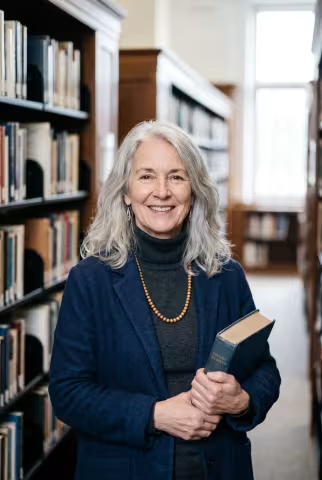
Senior faculty portrait, library stacks background — Person `person_portrait`.

Dr. Lena Scholz

Assistant Professor of Marine Mammal Science